 Step Rights Magazine Pralarg Magazine

Related Articles



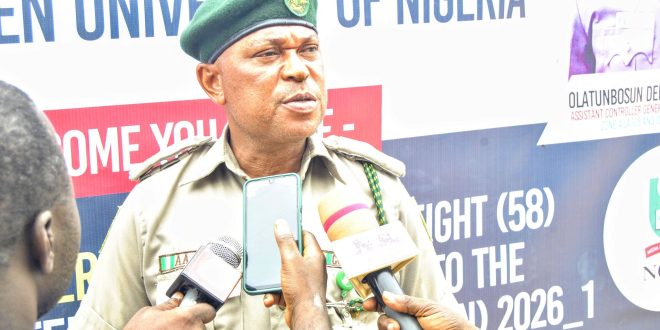
ABEOKUTA, NIGERIA — In a significant step toward correctional reform, the National Open University of Nigeria has formally admitted 58 inmates into its academic programmes at the Nigerian Correctional Service in Ogun State, reinforcing a growing shift from punishment to rehabilitation through education.

The matriculation ceremony, held at the Ibara Custodial Centre on April 16, 2026, reflects an expanding national strategy to use education as a tool for reintegration, dignity, and crime reduction.
Expanding Access Beyond Prison Walls
University officials described the event as more than a routine academic exercise, framing it instead as a transformative milestone for individuals often excluded from educational opportunities.
A representative of Vice-Chancellor Prof. Uduma Oji Uduma said the initiative embodies the university’s founding philosophy that education must not be limited by circumstance, emphasizing that open learning systems are reshaping global access to knowledge.
The inmates, now students, were urged to embrace discipline and self-direction, with officials stressing that success in distance learning depends heavily on personal commitment.
Nationwide, the university revealed that over 25,000 students were matriculated in the 2026 academic session, underscoring its rapidly expanding reach across diverse populations.
From Punishment to Rehabilitation
Officials of the Nigerian Correctional Service described the initiative as evidence of a broader institutional transition.
Representing the Ogun State Controller of Corrections, Deputy Controller Oriyemi called the programme a “triumph of the human spirit over circumstance,” noting that correctional facilities are increasingly adopting rehabilitation-focused policies.
He told the inmates:
“By choosing to study while in custody, you have demonstrated that your present situation does not define your future.”
Authorities say such educational programmes are critical in reducing recidivism and preparing inmates for productive lives after release.

Legal Angle: Education as a Right, Not a Privilege
The programme aligns with Nigeria’s correctional reform framework under the Nigerian Correctional Service Act 2019, which mandates rehabilitation, reformation, and reintegration as core objectives of incarceration.
Under the law:
- Inmates are entitled to educational and vocational training
- Correctional centres are required to promote human dignity
- Reintegration planning is recognized as essential to public safety
Legal analysts note that denying inmates access to education could undermine constitutional principles relating to human dignity and social justice, particularly under Section 34 of Nigeria’s Constitution.
This positions programmes like NOUN’s not merely as social interventions, but as legal and human rights obligations.
Reintegration Challenges and the Road Ahead

During the event, Welfare Officer Awesu Abdulhakeem Ayoola highlighted the systemic challenges awaiting inmates after release, including:
- Social stigma
- Unemployment
- Psychological trauma
He outlined four pillars for successful reintegration:
- Immediate post-release stabilization
- Economic empowerment
- Psychological and social support
- Long-term personal development
“Every module completed and every examination passed is a step away from stigma,” he said.
Global Context: A Growing Trend
Nigeria’s approach mirrors a broader global movement where prison education programmes in countries such as the United States, Norway, and the United Kingdom have demonstrated measurable reductions in reoffending rates.
Studies consistently show that inmates who receive education while incarcerated are significantly less likely to return to crime, making such initiatives both a human rights strategy and a cost-effective public safety measure.
Conclusion: Education as Freedom Beyond Bars
The matriculation of inmates in Ogun State signals a deeper transformation within Nigeria’s justice system—one that recognizes that true justice extends beyond punishment to restoration and opportunity.
As collaboration between the National Open University of Nigeria and the Nigerian Correctional Service continues to expand, education is increasingly becoming a bridge between incarceration and reintegration.
For the 58 inmates now turned students, the journey has only just begun—but it is one that offers a path not defined by past mistakes, but by future possibilities.
Olayemi Akinwunmi